
A practical starting point for listing agents
The market changes the opportunity
A 2% mortgage gets attention. A 5.25% mortgage may be the one that makes a purchase possible.
For listing agents, that distinction matters. An assumable mortgage can be a valuable feature, but its interest rate alone cannot tell you how to price the opportunity or advise your seller. The amount of debt available at that rate, the equity gap, the buyer’s alternatives, and the seller’s plans all influence the decision.
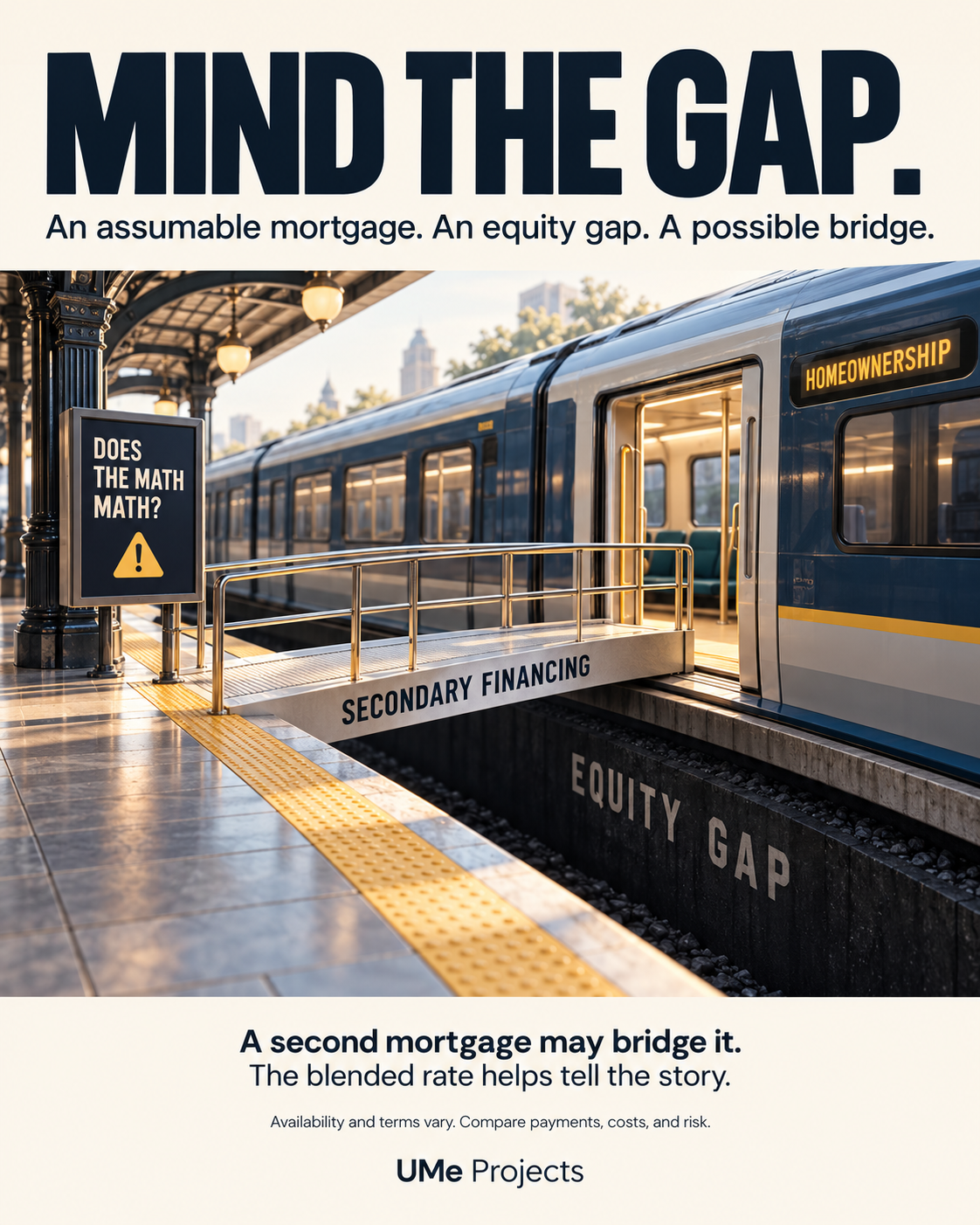
In “Mind the Gap,” we explored ways secondary financing can help bridge the difference between a purchase price and the remaining mortgage balance. The next question is what that financing opportunity is worth—and whether the seller can negotiate for some of its benefit.
As of October 8, 2026, Freddie Mac reported a 7.40% average for a 30-year fixed mortgage, up from 7.28% the previous week. That survey reflects conventional conforming purchase loans for borrowers with excellent credit and 20% down; it is a market benchmark, not a quote for every buyer.
In our conversations, we’re seeing interest in assumptions at 5.5% and 6%, alongside the 2% and 3% loans that still exist. A rate does not have to begin with a two to deserve a closer look. Its value depends on the financing the buyer could realistically obtain instead.
Price changes matter, too. Where a seller lowers the price while the remaining loan balance stays roughly the same, the equity gap shrinks. That can make the assumption usable for buyers who could not bridge it at the earlier price. Falling prices do not automatically establish an assumption premium; they change the transaction we need to evaluate.
Two homes and two different financing opportunities
Consider two hypothetical homes, each with a $500,000 purchase price.
The first has a $100,000 assumable mortgage at 2%. The buyer has a $400,000 equity gap before closing costs. Only 20% of the purchase price is covered by the assumed loan.
That can be appealing to a buyer with substantial cash. Someone who planned to pay cash may prefer to assume inexpensive debt and preserve liquidity. But for a buyer with limited cash, a 2% headline does not solve a $400,000 gap. If secondary financing is needed, its availability, cost, and qualification requirements become central to the comparison.
The second has a $485,000 assumable mortgage at 5.25%. The equity gap is $15,000 before closing costs. The assumed loan covers 97% of the purchase price.
Its rate is higher, but much more of the purchase is financed at that rate. For a qualified buyer who can cover the gap and transaction costs, this may be the more useful opportunity.
Which assumption is worth more? We cannot answer that from the rates alone. The right answer depends on who is buying, how they would finance the gap, and what alternatives they have. These figures also do not tell us the payment: remaining term and other loan details still need to be verified.
An equity gap can change without the rate changing
Suppose the second seller initially asks $525,000 while owing $485,000. The equity gap is $40,000 before closing costs. If the price drops to $500,000 and the balance is unchanged for this illustration, the gap becomes $15,000.
The rate has not changed. The amount the buyer must solve for has changed by $25,000.
That can change the likely buyer pool and whether secondary financing is needed. An equity gap is not necessarily all cash out of pocket: a buyer may cover some with permitted secondary financing. But that financing adds its own payment, costs, and requirements.
This is why assumption marketing should be refreshed as pricing changes. A listing’s financing story can change materially even when the seller’s note rate stays the same.
Buyer savings and a seller premium are different numbers
An assumption can create buyer savings without handing us a ready-made premium to add to the asking price.
Compare the complete assumption package with the buyer’s realistic new-financing alternative. Include the remaining term, any second mortgage, mortgage insurance where applicable, closing costs, cash required, and total monthly payment. When considering longer-term value, look beyond payment savings to interest costs, principal repayment, and the buyer’s expected ownership period.
A buyer expecting to move in three years may value the opportunity differently from someone planning to stay for fifteen. Future refinancing is uncertain. Multiplying a monthly payment difference by thirty years does not establish what a buyer should pay the seller today.
Then test any proposed premium against the revised transaction. If the $500,000 home with the $485,000 loan sells for $520,000, the equity gap grows from $15,000 to $35,000 before closing costs. The assumed loan does not increase with the price.
The buyer must solve that additional $20,000 through cash or another permitted source. If they need secondary financing, appraisal and combined loan-to-value requirements may affect what is possible.
The premium can consume some of the advantage being negotiated. A price that captures more savings for the seller may also leave fewer buyers able or willing to proceed.
The VA seller has a separate decision
For a VA seller, the buyer’s financial benefit is only one part of the conversation. The seller needs to understand what agreeing to the assumption means for their own plans.
Release of liability and restoration of entitlement are separate matters. An approved assumption can release the seller from responsibility for the loan while their entitlement remains committed to it. An eligible veteran buyer may substitute sufficient entitlement if VA’s requirements are met. Being a veteran alone does not accomplish substitution; the process must be completed, and substitution has additional requirements, including occupancy.
Without substitution, the entitlement generally remains tied to the loan until it is paid in full. The seller may still have enough remaining entitlement for another VA purchase, but that should be evaluated for the next transaction. If a future default results in a loss paid by VA, entitlement restoration can be affected even when the seller received a release of liability.
So we ask what the seller is doing next. Are they buying immediately? How much remaining entitlement is available? If both spouses are eligible veterans, what options actually exist for their household? Are they moving into assisted living, or expecting to use the benefit again later?
These circumstances change the seller’s tradeoffs and willingness to accept an assumption. They do not change the buyer’s payment savings by themselves. Separating those questions helps explain why two sellers with similar loans might make different decisions.
A starting point for listing agents
Start with the property. Establish its value from comparable sales before discussing what its financing might add to the negotiation.
Then verify the loan. Review the current balance, rate, remaining term, payment, loan type, servicer, and assumption requirements. Confirm what is available rather than relying on a headline rate or an old statement.
Next, understand the likely buyer. Calculate the gap at the proposed price, evaluate cash and any secondary financing, and compare the full package with realistic alternatives. Qualification and servicer approval remain necessary.
Review the seller’s plans separately. For a VA loan, evaluate entitlement implications. Consider processing time, carrying costs, contract terms, and the strength of the buyer’s qualification when comparing offers. A higher offer is not necessarily the better net outcome.
Finally, test the premium. Recalculate the gap and buyer economics at the higher price. Qualified buyer interest and actual offers help determine whether the market supports it.
The result may be an opportunity to negotiate a higher price. It may instead be stronger marketing, more interest, or a clearer path to a sale at the current price. Those are different forms of value, and all deserve consideration.
Education changes the conversation
As awareness grows, we see sellers who recognize their financing advantage and negotiate for it. We also see transactions where the assumption receives little attention because the seller or agent does not understand the option.
A buyer receiving a favorable loan does not automatically mean a seller made a poor decision. A seller may knowingly prioritize timing, certainty, or another goal over a premium. The concern is whether the decision was informed.
At UMe Projects, education is where we lead. Buyers, sellers, and agents should understand the terms, the economics, and the implications before making decisions.
I’ve tried to build an assumption valuation model several times. The math gives me a starting point. The people keep changing the answer.
We can calculate the financing benefit. We can evaluate the seller’s tradeoffs. The negotiated result still depends on what works for the people involved.
Agents, raise your hand if you have negotiated an assumption premium—or struggled to explain the value to a seller. What shaped the outcome?
Sources and example assumptions
Market context as of October 12, 2026: Freddie Mac, Mortgage Rates Average 7.40%, October 8, 2026. https://freddiemac.gcs-web.com/news-releases/news-release-details/mortgage-rates-average-740
VA entitlement guidance: VA Form 26-10291, Assumption Entitlement Acknowledgment, March 2024. https://www.vba.va.gov/pubs/forms/VBA-26-10291-ARE.pdf
VA assumption and release of liability guidance: VA Form 26-8978, Rights of VA Loan Borrowers. https://www.vba.va.gov/pubs/forms/26-8978.pdf
The property values, balances, rates, and premium in this article are hypothetical illustrations, not live listings or rate quotes. Gaps exclude closing costs and other transaction adjustments. Qualification, servicer approval, and any secondary financing requirements must be evaluated for the specific transaction. A price premium is not guaranteed.